
The UK has established itself as a global leader in space science education, making it an ideal destination to study Space Science in the UK through a combination of academic excellence, advanced research infrastructure, and strong international collaborations. UK universities are widely recognised for integrating theoretical knowledge with practical research, which allows students to actively engage in real scientific investigations.
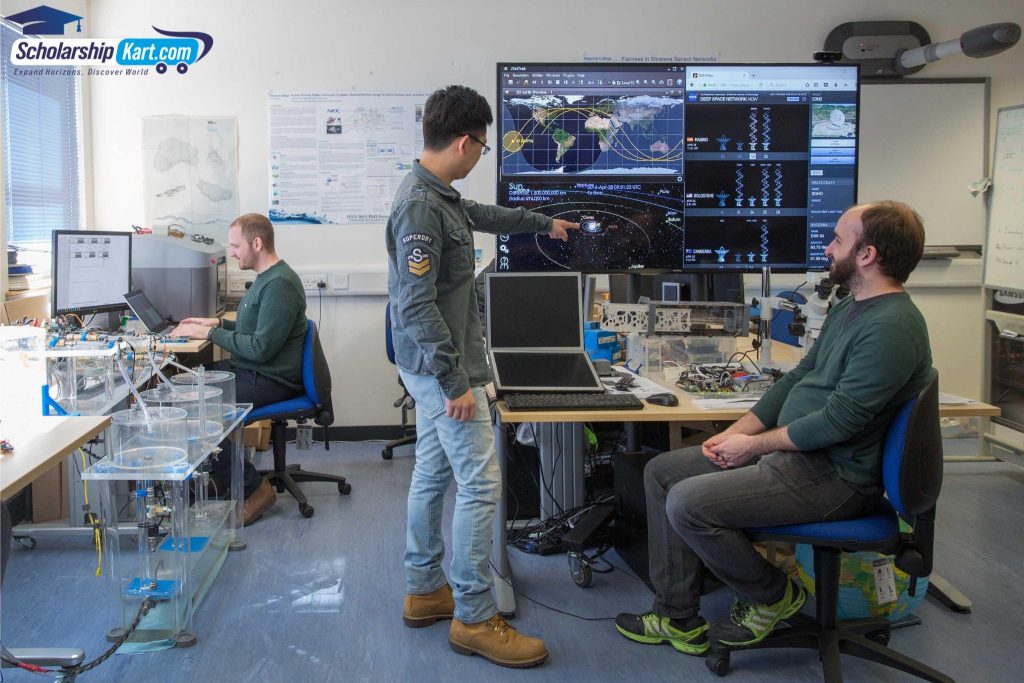
The country’s contribution to global space exploration, satellite technology, and astronomical research has strengthened its reputation as a centre for innovation in this field.
One of the key reasons behind the UK’s prominence is its close collaboration with international space organisations and research bodies. Universities often participate in global missions related to satellite development, planetary exploration, and deep-space observation.
According to the UK Space Agency, the UK space sector contributes billions to the economy and supports thousands of high-skilled jobs, highlighting the country’s strong investment in this domain. This connection between academia and industry ensures that students receive education that is both relevant and future-focused.
Do you want to build your future in the Space Science field? Connect with ScholarshipKart. Our expert counsellors help you find the ideal UK university and specialised course that matches your career aspirations. From expert guidance, IELTS preparation to tailored advice on course selection and university application, we ensure your journey begins with clarity and confidence. Connect with us today to take your first step.
What is Space Science?
Space Science is a broad field that focuses on the study of outer space and everything within it. It includes the exploration of celestial bodies such as planets, stars, galaxies, and cosmic phenomena.
The discipline also examines the physical processes that govern the universe, including gravity, radiation, and the formation of planetary systems.
This field is inherently interdisciplinary and draws knowledge from physics, astronomy, mathematics, engineering, and Earth sciences. Space scientists study how the universe was formed, how celestial bodies evolve, and how space environments influence planetary systems, including Earth.
The field also includes the study of satellites, space missions, and technologies that allow humans to explore and understand space.
Modern space science goes beyond observation. It involves the use of advanced tools such as telescopes, spacecraft, and simulation models to analyse data and make predictions. It also plays a crucial role in practical applications, including weather forecasting, communication systems, navigation, and environmental monitoring.
Benefits of Studying a Master’s in Space Science in the UK

1. Strong Academic Reputation and Research Excellence
UK universities are globally respected for their high academic standards and research output. Many institutions are involved in ground breaking discoveries in astronomy, astrophysics, and satellite science. This ensures that students are learning from experts who are actively contributing to advancements in space science.
2. Access to Advanced Facilities and Technology
Students benefit from access to modern laboratories, observatories, and simulation tools. These facilities support practical learning and allow students to work with real data from space missions, telescopes, and satellites. This hands-on experience is essential for building technical expertise.
3. Close Links with the Space Industry
The UK has a rapidly growing space sector, supported by organisations such as the UK Space Agency and private aerospace companies. Universities maintain strong connections with these organisations, offering students opportunities for internships, collaborative projects, and industry exposure.
4. Interdisciplinary Learning Opportunities
Space science programmes in the UK combine multiple disciplines, including physics, engineering, mathematics, and Earth sciences. This integrated approach helps students develop a comprehensive understanding of complex space systems and prepares them for diverse career paths.
5. Focus on Emerging Technologies and Innovations
Courses are designed to reflect current trends in space exploration and technology. Students learn about satellite systems, space instrumentation, data analysis, and planetary exploration. This ensures they are equipped with knowledge relevant to the evolving demands of the space industry.
6. Development of Practical and Transferable Skills
A Bachelor’s degree in Space Science emphasises the development of practical and transferable skills through hands-on laboratory work, data analysis, and the use of advanced simulation tools. Students gain experience in problem-solving, programming, teamwork, and scientific communication, which are essential for both research and industry roles.
A Master’s program in Space Science focuses on advanced practical training through research projects, laboratory experimentation, and the use of industry-standard analytical and computational tools. Students strengthen transferable skills such as critical thinking, independent research, project management, and effective communication in both academic and professional contexts.
7. Global Career Opportunities
A UK degree is widely recognised across the world, enhancing employability. Graduates can pursue careers in space agencies, research institutions, aerospace companies, and technology firms. The international reputation of UK education provides a competitive advantage in the global job market.
8. Diverse and International Learning Environment
The UK attracts students from different parts of the world, creating a multicultural academic environment. This diversity encourages collaboration, broadens perspectives, and enhances the overall learning experience.
Programme Structure and Areas of Study
Undergraduate programmes in Space Science typically provide a broad foundation in core scientific principles, including physics, mathematics, astronomy, and introductory space technology. The structure often combines lectures, laboratory work, and project-based learning, with modules covering topics such as planetary science, astrophysics, remote sensing, and basic programming.

In the later stages, students may choose optional subjects and complete a small research or design project to apply their knowledge.
Postgraduate programmes are more specialised and research-focused, allowing students to explore advanced topics such as satellite systems, space instrumentation, cosmology, orbital mechanics, and data analysis.
The structure usually includes taught modules in the first phase, followed by an independent research dissertation or thesis that develops in-depth expertise in a chosen area. Emphasis is placed on analytical skills, innovation, and the application of theoretical knowledge to real-world challenges in the space sector.
Sample Tuition Fees for Space Science Courses at UK Universities (2026)
| University of Kent | Astronomy, Space Science and Astrophysics BSc (Hons) | £23,500 per year |
| University of Southampton | Physics with Space Science (MPhys) | £31,000 per year |
| University of Hertfordshire | BSc (Hons) Astrophysics with Space Science | £17,450 per year |
| University of Leicester | BSc Physics with Space Science | £25,100 per year |
| Aberystwyth University | BSC Space Science and Robotics | £21,875 per year |
| University of Glasgow | MSc Space Science | £31,050 |
| Cranfield University | Astronautics and Space Engineering MSc | £33,045 |
| University College London | Space Science and Engineering: Space Science MSc | £46,700 |
| University of Birmingham | Space Engineering MSc | £33,660 |
| Aberystwyth University | Space Engineering MSc | £22,410 |
Career Opportunities in Space Science
- Careers in the space industry offer many different paths and cover a wide range of fields. There are many kinds of jobs available for people with different skills, from photography to space law, so almost anyone can find a place in this field.
- If you want to work in this area, you should look for roles that match your skills and strengths. This will help you find the right career, as there are many options to choose from.
- If you are interested in space science, you can explore areas like engineering and manufacturing, where people design and build spacecraft and equipment.
- You can also look into politics, government, and the public sector, where decisions about space missions and policies are made.
- Another option is IT, data, and technology, which involves working with software, data analysis, and systems used in space projects.
- You may also consider energy and Earth resources, which focus on studying our planet and its resources using space technology.
- Science, research, and development are other important areas where new ideas and discoveries in space are explored.
Careers in Space
- Astro-ecologists
- Astronauts
- Data Scientists
- Geoscientists
- Project Managers
- Public Relations Specialists
- Satellite Technologists
- Software Developers
- Space Academics
- Spacecraft Operators
- Systems Engineers
Entry Requirements for International Students
Bachelor’s degree in Space Science: International students applying for a Bachelor’s degree in Space Science in the UK are typically required to have completed secondary education with strong grades in mathematics and physics or related subjects.

Many institutions expect academic qualifications equivalent to UK A-levels, International Baccalaureate, or other nationally recognised certifications.
Master’s in Space Science: International students applying for a Master’s in Space Science in the UK are generally required to hold a qualification equivalent to a UK 2:1 honours degree in a relevant subject such as physics, astronomy, engineering, or a related scientific discipline.
A strong academic background is essential, particularly in subjects that involve mathematics and analytical thinking.
Applicants are expected to demonstrate good numerical and problem-solving skills, as space science relies heavily on data analysis and mathematical modelling. Familiarity with key concepts in physics and mathematics is particularly important for understanding advanced topics within the programme.
English language proficiency is mandatory for international students. Typically, universities require an IELTS Academic score of around 6.5 overall, with no less than 6.0 in each component, although exact requirements may vary between institutions.
Popular Universities to Study Space Science in the UK
- University College London
- University of Edinburgh
- University of Southampton
- University of Oxford
- University of Cambridge
- University of Manchester
- Durham University
- University of Glasgow
- Imperial College London
- Cranfield University
- University of Leicester
- University of Birmingham
- University of Sussex
- University of Bath
- University of Warwick
- University of Hertfordshire
- University of Bristol
- University of Exeter
- University of Kent
- King’s College London
- Queen’s University Belfast
- Aberystwyth University
Conclusion
Studying a Space Science degree in the UK offers a unique blend of academic excellence, practical experience, and global exposure. The country’s strong research culture, advanced facilities, and close ties with the space industry make it an ideal destination for aspiring space scientists.

With opportunities to engage in real-world research and explore cutting-edge technologies, students gain both knowledge and skills that prepare them for successful careers. For those fascinated by the universe and driven by discovery, pursuing space science in the UK can be a transformative and rewarding journey.
If you desire to pursue a Space Science degree in the UK, Book a Free consultation with ScholarshipKart. You’ll receive end-to-end support, from application assistance, scholarship guidance, and a focused visa application, designed to make your transition to the UK seamless. Turn your ambition of studying FinTech into a reality. Let’s make it happen together.
FAQs (Frequently Asked Questions)
Space Science focuses on understanding the universe, including planets, stars, galaxies, and space environments. A space science programme usually covers areas such as astrophysics, planetary science, satellite technology, and space data analysis.
Students with a background in physics, astronomy, engineering, mathematics, or related scientific fields are generally eligible. A strong academic record and good analytical skills are important for admission.
Yes, mathematics plays a crucial role in space science. It is used for modelling, data analysis, and understanding physical processes in space, so students should be comfortable with quantitative concepts.
Graduates can work in space agencies, aerospace companies, research institutions, and technology firms. Some may also pursue careers in data science, education, or continue with doctoral research.
Yes, most programmes include hands-on learning through lab work, simulations, and research projects. Students often complete a dissertation based on real scientific data or current research topics.
While prior knowledge of astronomy can be helpful, it is not always mandatory. A strong foundation in physics and mathematics is usually more important, as core concepts are taught during the programme.
Yes, international students must demonstrate English proficiency. Most universities require an IELTS Academic score of around 6.5 overall, with minimum scores in each section.
The UK offers high-quality education, advanced research facilities, and strong links with the global space industry. This combination provides students with excellent academic training and career opportunities.