
What happens when a change in interest rates in one part of the world influences investment decisions somewhere else? What if a business decision involves currency risk, international tax considerations and different regulatory requirements at the same time?

This is the reality of modern finance.
Today’s financial landscape is no longer confined by national borders. Capital can move across continents in milliseconds, financial institutions operate within complex international obligations, and regulatory decisions in one financial hub can influence markets worldwide. For anyone interested in banking, finance, financial markets, investment, corporate finance or risk management, understanding these connections is becoming increasingly important.
The UK is home to some of the world’s most respected universities, offering internationally recognised Master’s programmes in Banking and Finance. These programmes combine strong academic foundations with advanced learning in areas such as financial markets, investment, risk management, corporate finance and banking.
UK universities are known for preparing students to understand the complexities of global finance and make informed, strategic financial decisions. With internationally valued qualifications and exposure to diverse financial perspectives, a UK Master’s can provide a strong foundation for pursuing opportunities across the global banking and finance sector.
Planning to study Banking and Finance in the UK? Let ScholarshipKart help you get started. From choosing the right university and course to personalised counselling, university admissions, scholarships and visa guidance, our experts can support you at every step of your study-abroad journey.
Let’s explore first why study Banking and Finance in the UK? Here are 10 compelling reasons.
Why Study Banking and Finance in the UK? Discover Where Global Finance Takes You
Studying Banking and Finance in the UK is an opportunity to develop a broader understanding of how money, markets, institutions and regulation interact.
Rather than viewing finance as simply the management of money, the subject explores the systems through which money and assets move, businesses are funded, investments are assessed, risks are managed and financial decisions are made.
1. Learn Finance Through a Global Lens

The UK offers an internationally focused academic environment for understanding how money, credit, investment and financial assets move through modern economies. Its universities provide students with the opportunity to examine how organisations raise capital through equity or debt, manage cash flows and liquidity, evaluate investment opportunities and respond to financial risk.
A Master’s degree in this field goes beyond basic financial concepts. It explores how financial markets operate, how assets are valued and how corporate financial decisions affect businesses and their stakeholders. This broader perspective is particularly relevant in a world where financial activity increasingly crosses national boundaries.
2. Understand the Interconnected Nature of Financial Markets
Modern financial markets do not operate in isolation. Capital moves between countries, multinational institutions operate across jurisdictions and regulatory decisions can influence financial activity well beyond their place of origin.
The UK’s internationally oriented financial education can help students examine these relationships in greater depth. They can explore how an interest-rate change in one economy can influence investment flows elsewhere or how regulatory reforms in major financial centres can affect institutions operating internationally.
Developing this perspective can be valuable for anyone seeking to understand global finance, international banking and cross-border financial decision-making.
3. Explore Banking Within an International Financial Centre
Banks are central to the financial system. They facilitate credit, financing and the circulation of money, while financial institutions and investment houses support activities spanning investment, asset management and financial intermediation.
The UK’s strong connection with international finance provides a relevant setting for exploring how these institutions function and interact with businesses, investors and governments. Students can examine the relationship between banks and financial markets while developing an understanding of how capital moves through the wider financial system.
This exposure can provide useful context for those considering professional paths within banking and financial services.
4. Develop Advanced Financial Analysis Skills

Contemporary finance demands more than an understanding of financial terminology. Professionals need to interpret data, analyse market movements, evaluate financial risk and communicate recommendations clearly.
A postgraduate programme can help develop these analytical and critical-thinking abilities through areas such as financial statement analysis, investment evaluation and market assessment. Students learn to approach complex financial situations systematically rather than relying solely on theoretical knowledge.
These skills are relevant across financial analysis, investment, consulting, corporate finance and other areas where decisions need to be supported by evidence.
5. Build Knowledge of Investment and Portfolio Management
Understanding investment requires more than identifying potentially attractive assets. Financial professionals must consider asset pricing, portfolio construction, allocation, market movements and risk.
Master’s-level study introduces concepts such as portfolio theory, investment analysis, derivatives, asset allocation and risk management. Portfolio theory can help students understand more sophisticated approaches to allocating assets, while derivatives provide insight into financial instruments used in hedging and risk management.
This knowledge can strengthen your ability to assess investment decisions within uncertain and constantly changing markets.
6. Gain Insight into Financial Regulation and Risk
Financial institutions operate within regulatory frameworks that influence how they manage capital, risk and financial activity. As markets become increasingly interconnected, professionals must also understand how regulatory requirements can differ between jurisdictions.
The UK academic environment provides scope to explore these relationships through subjects connected with financial regulation, risk management and international finance. Basel III, for example, illustrates how international regulatory requirements can shape the operations and risk frameworks of financial institutions.
International transactions can involve additional considerations, including differences in disclosure standards and regional regulatory requirements. Understanding these complexities can strengthen the ability to evaluate financial risk in a global context.
7. Prepare for Strategic Finance Roles
Technical expertise can establish a foundation for a finance career, but moving towards senior, managerial or advisory positions requires broader capabilities. Professionals need to evaluate complex situations, interpret evidence and understand the wider implications of financial decisions.
Advanced postgraduate education can strengthen strategic financial thinking, evidence-based judgement, analytical ability and professional communication. These skills can help learners progress from performing individual financial tasks to contributing to broader organisational discussions and decisions.
For professionals with leadership ambitions, developing this combination of technical and strategic capability can be particularly valuable.
8. Access Diverse Career Pathways
Banking and Finance is a broad discipline, which means a postgraduate qualification can support multiple professional directions rather than limiting graduates to a single role.
Career opportunities can span international banking, corporate finance, treasury, financial consulting, asset and wealth management, risk, compliance and regulatory environments. Potential roles include investment banking analyst, portfolio manager, risk manager, corporate treasurer, financial analyst, treasury analyst and compliance officer.
The knowledge can also be relevant to professionals pursuing opportunities in areas such as hedge funds and private equity. This range makes the discipline suitable for students with different interests within the financial services industry.
9. Gain International Exposure Through Diverse Cohorts
Finance is inherently international, and a multicultural learning environment can add another dimension to postgraduate education. UK universities attract students and professionals from different countries, industries and backgrounds, creating opportunities to encounter varied perspectives on financial markets and business.
Discussions around portfolio management, investment strategies and regulatory frameworks can become more insightful when learners bring experiences from different jurisdictions. Such interaction can help students understand how financial practices vary internationally while developing greater confidence in cross-cultural professional settings.
It can also provide an opportunity to build relationships with peers from different parts of the world and develop an international professional network.
10. Develop Skills for a Financial Sector That Continues to Evolve
The financial industry is constantly changing. Markets, regulations, investment approaches, economic conditions and financial institutions continue to evolve, creating new challenges for professionals.
Postgraduate education can help students keep pace with these developments by exploring areas such as sustainable investing, monetary policy, international markets, financial risk and data-driven decision-making. These subjects encourage learners to look beyond established financial models and consider how emerging developments can influence future decisions.
More importantly, advanced study can develop the ability to assess unfamiliar financial situations, interpret evidence and make informed judgements. These capabilities can remain valuable even as specific financial practices and market conditions change.
Leading UK Universities for a Master’s in Banking and Finance
Banking & Finance MSc- King’s College London

The Banking & Finance MSc at King’s College London offers an in-depth exploration of modern banking and financial markets while developing strong research, analytical and critical-thinking abilities.
The programme covers investment analysis, portfolio management, commercial and investment banking, asset and risk management, mergers and acquisitions, derivatives, quantitative finance, taxation and banking regulation.
Students can also gain practical exposure through state-of-the-art facilities, including a virtual trading floor, alongside specialised financial and economic databases and industry-relevant software.
Located in the heart of London, King’s Business School combines research-led teaching with industry connections, making it particularly suitable for students with a quantitative background in finance, economics or a related degree.
Banking and International Finance MSc- Bayes Business School
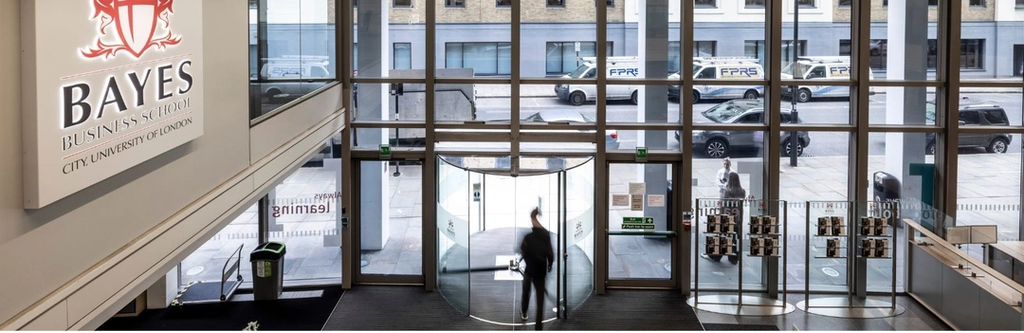
The Banking and International Finance MSc at Bayes Business School (City St George’s) combines academic learning with hands-on industry exposure.
Students can explore emerging areas including digital finance, cryptocurrencies, blockchain, sustainable finance, financial crime, investment strategy, M&A, trading and hedging. Its experiential approach includes industry projects, company visits and sessions with professionals from leading financial organisations.
Students may also benefit from exposure to institutions such as the Bank of England and ECB, alongside visits to organisations including Revolut, Lloyds and Bloomberg.
Located in London, Bayes provides access to a vibrant financial ecosystem, while its AI-focused learning helps students develop relevant digital skills for the evolving finance industry.
Finance with Banking MSc- University of Bath

The Finance with Banking MSc at the University of Bath combines a strong theoretical foundation with practical learning, preparing students for careers across finance and banking.
The programme develops expertise in areas such as financial decision-making, financial modelling, programming and FinTech, while industry input helps students engage with contemporary issues shaping the sector.
Students can tailor their studies through optional units and choose between a dissertation or internship during the summer term.
Another advantage is access to specialist financial databases and terminals, including Bloomberg, Refinitiv Workspace, Morningstar Direct and Wharton Research Data Services. An international student community also provides opportunities to gain broader perspectives on finance and banking.
Money, Banking and Finance MSc- University of Birmingham

The Money, Banking and Finance MSc at the University of Birmingham combines contemporary academic knowledge with practical, industry-focused learning.
Students develop expertise in monetary economics, macroeconomics, responsible banking and the wider relationship between money, banking and finance within the global economy.
The programme provides hands-on experience through industry workshops, training, company visits and the opportunity to complete a company-based dissertation.
With responsible business at its core, students also explore how environmental, social and governance factors influence financial risks and opportunities.
Based in Birmingham, the UK’s Second City and an important financial centre, the programme benefits from research-led teaching informed by the latest academic thinking and faculty expertise.
Money, Banking and Finance MSc- Lancaster University

The Money, Banking and Finance MSc at Lancaster University combines theoretical knowledge with practical skills for careers in banking, finance, government and regulatory organisations.
Students develop expertise in financial data analysis, banking regulation, financial stability and professional ethics, alongside practical experience with Bloomberg, statistical software and Python programming.
The programme also covers econometrics, forecasting, risk assessment and the functioning of financial markets and banking systems. Teaching draws on Lancaster University Management School’s research strengths in finance, banking and monetary economics, while guest lectures provide opportunities to engage with industry professionals.
A further advantage is Chartered Banker Status awarded on completion, offering a recognised professional qualification for those pursuing careers across the global banking sector.
Banking, Economics and Finance MSc- Cranfield University

The Banking, Economics and Finance MSc at Cranfield University brings together three closely connected disciplines- banking, economic, and finance, preparing students for careers across financial services, the public sector and consultancy.
The programme combines core academic knowledge with practical learning, including opportunities to work on real business challenges set by industry partners. Students also develop critical thinking, communication and research skills relevant to today’s evolving financial landscape.
Teaching is delivered by faculty with extensive industry experience and links with global financial services organisations, multinational companies and government agencies. Alumni engagement further supports networking with potential employers throughout the programme.
Accredited by the Chartered Banker Institute, the course also provides a direct pathway towards Chartered Banker status, with successful completion of the PG Diploma modules leading to the Associated Chartered Banker qualification.
Money, Banking and Finance MSc- University of Sheffield

The Money, Banking and Finance MSc at the University of Sheffield combines advanced financial and economic theory with practical quantitative skills relevant to modern banking and global finance.
Students explore areas including macroeconomic analysis, econometric methods, banking theory and monetary economics, developing the ability to evaluate financial trends, policies and market dynamics.
Research-active academics support students throughout the programme, while a range of optional modules allows them to tailor their studies to their interests and career goals.
The course also includes an independent research dissertation, giving students the opportunity to investigate a real-world monetary or financial challenge.
By graduation, students develop strong technical and analytical capabilities suited to careers in finance, industry or further research.
Global Banking and Finance MSc- University of Bristol

The Global Banking and Finance MSc at the University of Bristol develops advanced knowledge of banking, financial markets and the global financial system.
Students explore asset pricing, risk management, financial regulation and financial stability while building strong quantitative, econometric and data-analysis skills. The research-led curriculum also covers areas such as financial technology, derivatives, financial modelling and sustainable finance, helping students understand changing financial environments.
Practical learning is supported by specialist facilities, including the Bloomberg Room, where students can work with industry-standard financial and market data tools.
Access to collaborative spaces, industry connections and dedicated careers support further helps students develop analytical expertise, professional networks and practical experience for careers in global banking and finance.
Banking and Finance MSc- Queen Mary, University of London

The Banking and Finance MSc at Queen Mary provides professional postgraduate training for students and practitioners aiming for careers across banking, financial institutions, government and the wider financial sector.
The programme covers commercial and investment banking, investment analysis, financial statements, risk and portfolio management, banking regulation and quantitative methods.
Students develop the ability to apply financial models and analytical techniques to real-world problems through lectures, workshops, computer-based exercises and an individual research project.
The programme also explores contemporary issues shaping international financial systems and encourages independent, systematic thinking.
Its affiliation with the Global Association of Risk Professionals and the FRM certification provides additional relevance for careers in financial risk. Optional maths and statistics modules are available for students needing further quantitative preparation.
Entry Requirements for a Master’s in Banking and Finance in the UK
Applicants will typically need an upper second-class honours undergraduate degree, or international equivalent, in a quantitative subject such as Finance, Economics, Accounting, Mathematics, Engineering, Computer Science, Physics, Actuarial Sciences or Data Science.
For English proficiency, an IELTS score of 6.5 overall, with at least 6.0 in each component, or an accepted equivalent, is generally required.
Career after a Master’s in Banking and Finance in the UK
- Commodity broker
- Corporate investment banker
- Financial adviser
- Financial trader
- Investment analyst
- Investment fund manager
- Operational investment banker
- Retail banker
- Stockbroker
Expected Salary After a Banking and Finance Degree
Banking and finance can offer strong earning potential, particularly as professionals progress into specialised and senior roles. Salary progression in banking and finance generally depends on experience, specialisation, performance, seniority and the type of organisation. Graduate roles typically offer a starting salary, while earnings can increase as professionals move into specialist, managerial and leadership positions.
According to the 2025 High Fliers report, investment banking is among the highest-paid graduate careers, with a median starting salary of £55,000. Across the broader banking and finance sector, the median graduate starting salary is £45,500.
Investment banking may also include performance-related bonuses, which can significantly affect total compensation. As careers progress, roles such as senior analysts, managers, controllers, Finance Directors and CFOs can command substantially higher salaries.
Salary levels vary considerably depending on the role, experience and seniority. Investment bankers and analysts can typically start around £45,000–£55,000, while finance or business analysts may earn £35,000–£67,500. Credit analysts can reach £100,000+ at senior levels, while management accountants/controllers may earn £48,000–£140,000. At executive level, Finance Directors and CFOs can earn £120,000–£325,000+.
Conclusion
Banking and Finance is ultimately about understanding how money, markets, institutions and decisions connect. Its relevance extends from corporate funding and cash-flow management to investments, financial markets, regulation and risk.
The increasingly interconnected nature of global finance means professionals must look beyond individual markets and understand the relationships between economies, institutions and regulatory systems. A strong foundation in global finance, banking, investment, corporate finance, financial markets and risk management can therefore support a wide range of professional ambitions.
For students and professionals considering advanced study, a Master’s in Banking and Finance in the UK can offer academic rigour, flexibility and an international perspective. It can strengthen financial analysis, portfolio and risk evaluation, data-driven decision-making, critical research and professional communication while exposing learners to diverse perspectives on global finance.
In a financial world where decisions can cross borders in seconds, the ability to understand those connections is more than an academic advantage—it is a foundation for making better financial decisions and pursuing opportunities across the global finance industry.
Take the Next Step Towards a Banking and Finance Career

Turn your ambition to study Banking and Finance in the UK. Book a Free Consultation with ScholarshipKart for expert counselling, admission assistance, scholarship guidance and visa support. Get personalised guidance to make your UK study-abroad journey simpler and more confident.
FAQs
1. Can international students study a Master’s in Banking and Finance in the UK?
Yes, UK universities welcome applications from students worldwide who meet the academic and English language requirements. International applicants can choose from a wide range of Banking and Finance Master’s programmes with different specialisations and entry criteria.
2. What academic qualifications do international students need?
International applicants generally need a recognised undergraduate degree equivalent to the UK entry requirement, often in finance, economics, accounting or another relevant quantitative subject. Some universities may accept students from other disciplines if they have sufficient mathematical or analytical experience.
3. Do I need IELTS to study Banking and Finance in the UK?
Most international students need to demonstrate English language proficiency unless they qualify for an exemption. IELTS requirements vary by university, but many programmes require an overall score around 6.5 with minimum scores in individual components.
4. How much does a Banking and Finance Master’s cost for international students?
Tuition fees vary depending on the university and programme, and international fees are generally different from UK student fees. Students should also budget for accommodation, living expenses, travel, visa costs and other study-related expenses.
5. Can international students apply for scholarships for Banking and Finance?
Yes, international students may be eligible for university scholarships, country-specific awards and other funding opportunities. Requirements and deadlines differ, so it is advisable to explore scholarship options before submitting your application.
6. Can I work in the UK after completing a Banking and Finance Master’s?
International graduates may be able to remain in the UK after their studies under applicable post-study immigration routes, subject to the rules in force at the time of application. Your eligibility and permitted stay will depend on the relevant visa requirements.
7. What careers can international students pursue after a Banking and Finance Master’s?
Graduates can explore opportunities in areas such as investment banking, financial analysis, risk management, commercial banking, investment management and financial consultancy. Career options can depend on your skills, experience, employer requirements and the immigration rules applicable to your circumstances.
8. How can international students strengthen their application for a Banking and Finance Master’s in the UK?
A strong application should clearly demonstrate your academic background, quantitative abilities, relevant experience and motivation for studying Banking and Finance. A well-prepared personal statement and carefully selected universities can help present your profile effectively.