
Mechanical Engineering is one of the most versatile engineering disciplines, combining mathematics, physics, design, manufacturing, materials science and technology to solve real-world engineering problems.
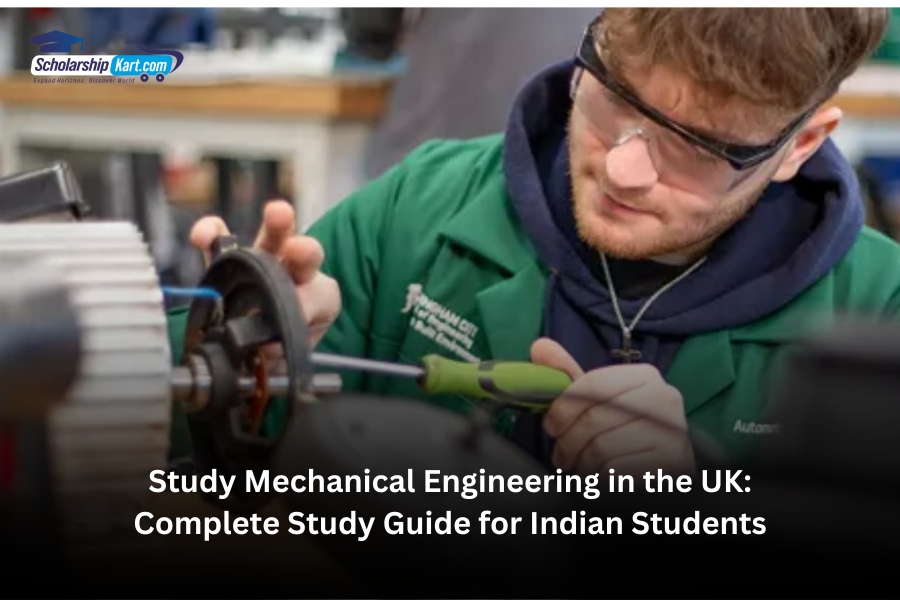
For Indian students, studying Mechanical Engineering in the UK can provide access to internationally recognised universities, modern laboratories and industry-focused teaching.
UK universities offer Mechanical Engineering programmes at undergraduate, postgraduate and doctoral levels, allowing students to choose a course that matches their academic and career goals.
Many programmes emphasise practical learning through laboratory work, computer-aided design, engineering projects, simulations and industry-based assignments.
The UK is also home to major engineering, automotive, aerospace, energy, manufacturing and technology companies, creating opportunities to understand how engineering principles are applied in professional environments.
Another advantage is the wide range of specialised courses, including robotics, aerospace engineering, renewable energy, automotive engineering, manufacturing and mechatronics.
A UK engineering degree can also strengthen a student’s international academic profile because British universities have a strong reputation for engineering education and research.
For Indian students, the relatively focused structure of many UK master’s programmes can be particularly attractive because several postgraduate degrees can be completed in one year of full-time study.
Students can also benefit from university careers services, engineering societies, research projects, internships and opportunities to develop professional skills alongside technical knowledge.
Overall, studying Mechanical Engineering in the UK can provide Indian students with a combination of academic knowledge, practical experience, international exposure and preparation for careers in a wide range of engineering industries.
Why Study Mechanical Engineering in the UK?
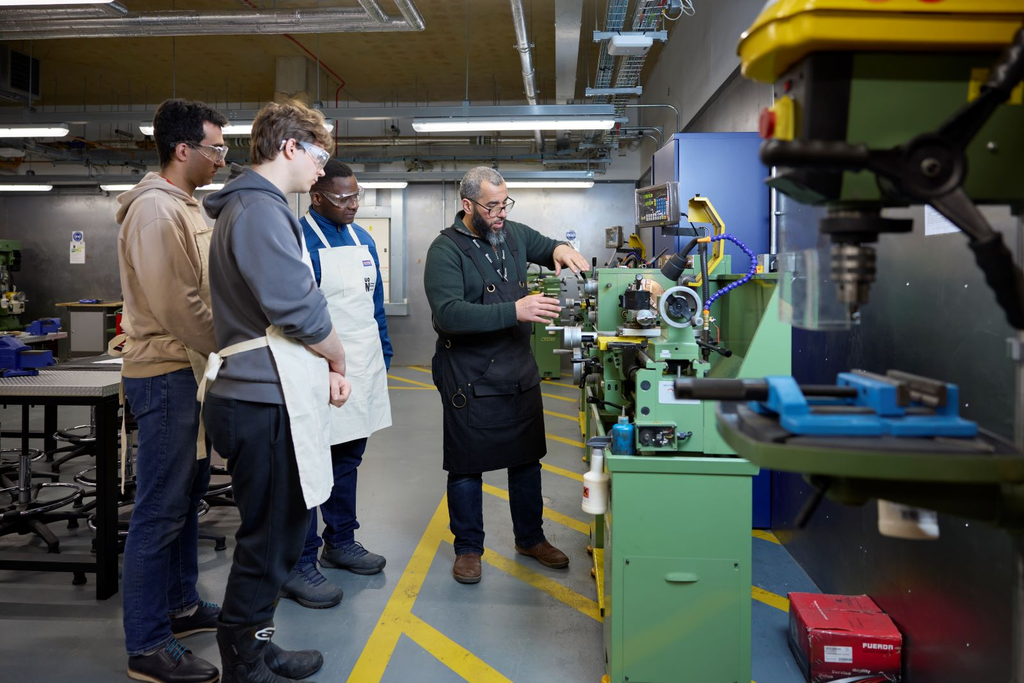
The UK has a long-established engineering education system with universities that combine theoretical teaching with practical engineering applications.
Mechanical Engineering students can study subjects ranging from thermodynamics and fluid mechanics to robotics, advanced manufacturing, materials and computational engineering.
Many universities also maintain links with engineering companies, research organisations and professional engineering bodies, helping students understand industry expectations.
The UK’s diverse engineering sector offers potential career opportunities in automotive, aerospace, energy, manufacturing, construction, transportation and emerging technologies.
For international students, the UK’s globally recognised qualifications and multicultural academic environment can make Mechanical Engineering an attractive option for building an international career.
Key Benefits of Studying Mechanical Engineering in the UK
1. Internationally Recognised Engineering Education
UK universities are widely recognised for their academic standards and engineering research. A Mechanical Engineering qualification from a reputable UK university can demonstrate that a student has studied engineering principles within a structured and academically rigorous environment. This can be valuable when applying for jobs or further education in the UK, India and other international markets.
2. Strong Focus on Practical Learning
Mechanical Engineering is not limited to classroom theory in the UK. Students may work with engineering laboratories, computer-aided design software, simulation tools, manufacturing equipment and experimental systems. Practical assignments allow students to apply concepts such as mechanics, thermodynamics and materials science to realistic engineering problems.
3. Wide Choice of Specialisations
Students can select programmes according to their interests and long-term career plans. Depending on the university, specialisations may include automotive engineering, aerospace systems, robotics, mechatronics, renewable energy, manufacturing, computational engineering, design engineering and advanced materials. This flexibility allows students to develop expertise in a particular area of Mechanical Engineering.
4. Industry-Oriented Curriculum
Many UK Mechanical Engineering courses are designed with professional engineering requirements and industry applications in mind. Students may complete design projects, group assignments, industrial case studies or placements that help them understand engineering practices outside the classroom. This exposure can make the transition from university to employment smoother.
5. Access to Modern Research and Technology
The UK has an active engineering research environment covering areas such as sustainable energy, electric vehicles, robotics, advanced manufacturing, artificial intelligence and materials. Students, particularly at postgraduate and doctoral levels, may have opportunities to work with advanced equipment, computational methods and research techniques.
6. Strong Career Versatility
A Mechanical Engineering degree does not restrict graduates to one profession. The technical and analytical skills developed during the course can be applied to automotive, aerospace, energy, manufacturing, consulting, construction, transportation, product development and technology-related roles. Graduates can therefore explore several career directions rather than relying on a single industry.
7. Professional Development Opportunities
UK universities commonly provide careers support, employability workshops, networking opportunities, engineering societies and professional development activities. Students can improve skills such as technical communication, teamwork, project management, problem-solving and professional presentation. These skills are important because engineering employers generally look for more than technical knowledge alone.
8. International Exposure
Studying in the UK places students in an international academic environment where they interact with classmates from different countries and backgrounds. This can improve communication, teamwork and cultural awareness. Such experience can be especially useful for students who intend to work with multinational engineering companies or pursue careers outside India.
Types of Mechanical Engineering Degrees in the UK
Mechanical Engineering can be studied at three major academic levels in the UK: undergraduate, postgraduate and doctoral level. Each level has a different purpose, academic depth and entry requirement.
Undergraduate Mechanical Engineering Degrees
Undergraduate programmes are designed for students who have completed secondary school or an equivalent qualification and want to build a foundation in engineering. Common qualifications include Bachelor of Engineering (BEng) and Master of Engineering (MEng) degrees.
A BEng usually provides a broad education in Mechanical Engineering and covers subjects such as engineering mathematics, mechanics, materials, thermodynamics, fluid mechanics, manufacturing and engineering design. Students may also complete individual or group design projects.
An MEng is an integrated master’s degree that combines undergraduate and advanced master’s-level study into one programme. It generally provides greater depth than a standard BEng and may include advanced design, systems engineering, research or industry-focused modules.
Postgraduate Mechanical Engineering Degrees
Postgraduate study is suitable for students who already hold an undergraduate degree and want to specialise or develop advanced technical knowledge. The most common qualification is a Master of Science (MSc).
An MSc in Mechanical Engineering may focus on areas such as advanced mechanical engineering, automotive engineering, robotics, energy systems, manufacturing, computational engineering, aerospace systems or mechatronics. Depending on the course, students may complete taught modules followed by a substantial research, design or engineering project.
Postgraduate study can be particularly useful for graduates who want to move into a specialised engineering field or strengthen their academic profile before entering industry or research.
PhD in Mechanical Engineering
A Doctor of Philosophy (PhD) is the highest academic research qualification in Mechanical Engineering. Unlike a taught master’s degree, a PhD is primarily focused on producing original research.
PhD students investigate a specific engineering problem under the supervision of academic researchers. Their work may involve experiments, numerical modelling, simulation, laboratory research, product development or a combination of different methods.
A PhD is generally appropriate for students who want to pursue careers in academic research, advanced industrial research and development, specialist engineering research or university teaching.
Popular and Specialised Mechanical Engineering Degrees in the UK

Popular Undergraduate Degrees in Mechanical Engineering
Common undergraduate options include:
- BEng Mechanical Engineering
- BEng Mechanical Engineering with Manufacturing
- BEng Automotive Engineering
- BEng Mechanical and Electrical Engineering
- MEng Mechanical Engineering
- MEng Mechanical Engineering with Robotics
- MEng Mechanical Engineering with Aerospace Applications
- MEng Mechanical Engineering with Energy Systems
These programmes usually establish core engineering knowledge before allowing students to explore advanced or specialised topics.
Popular Postgraduate Degrees in Mechanical Engineering
At master’s level, students can choose programmes such as:
- MSc Mechanical Engineering
- MSc Advanced Mechanical Engineering
- MSc Automotive Engineering
- MSc Robotics and Autonomous Systems
- MSc Mechatronics
- MSc Manufacturing Engineering
- MSc Renewable Energy Engineering
- MSc Energy Systems
- MSc Computational Engineering
- MSc Aerospace Engineering
- MSc Engineering Design
The right specialisation depends on the student’s previous education, technical interests and intended career path.
Specialised PhD Areas in Mechanical Engineering
Mechanical Engineering PhD research can cover highly specialised areas, including:
- Robotics and autonomous systems
- Electric and hybrid vehicle technology
- Renewable energy systems
- Computational fluid dynamics
- Advanced materials
- Additive manufacturing
- Thermal engineering
- Sustainable manufacturing
- Aerospace engineering
- Artificial intelligence in engineering
- Energy storage and conversion
- Mechanical design and optimisation
PhD research topics are normally developed around the expertise of a university department and the research interests of potential supervisors.
Mechanical Engineering Course Duration in the UK
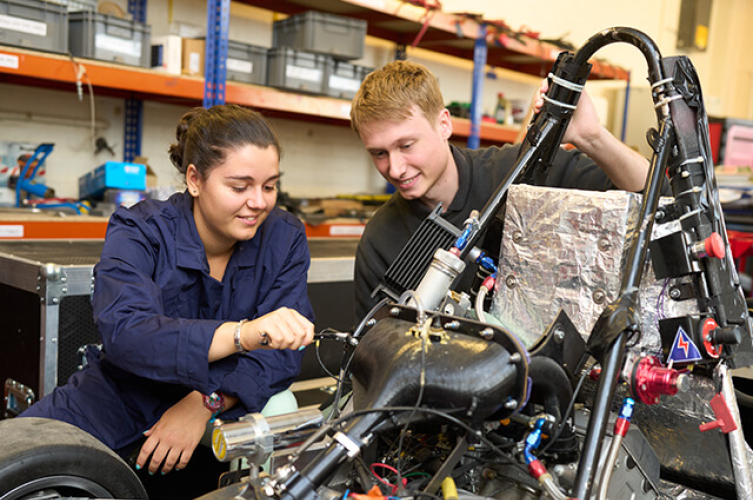
The duration of a Mechanical Engineering degree depends on the qualification, university and course structure.
A standard BEng Mechanical Engineering usually takes around three years of full-time study in England, Wales and Northern Ireland. Some programmes offer an optional placement year, which can extend the course to approximately four years.
An MEng is commonly structured as a four-year integrated programme. It combines bachelor’s-level study with advanced master’s-level engineering education. Students who complete the required stages graduate with an integrated master’s qualification.
A full-time MSc Mechanical Engineering is often completed in one year in the UK. Some programmes may be longer if they include an industrial placement, extended project or part-time structure.
A PhD normally takes around three to four years of full-time study, although the exact duration varies according to the research project, university regulations and student’s circumstances.
Students should always check the specific university’s course structure because placement years, foundation years and optional study periods can change the overall duration.
Tuition Fees for Mechanical Engineering Courses in the UK
Tuition fees vary considerably according to the university, degree level, course specialisation and students’ fee status. International students, including students from India, generally pay international tuition fees, which are often higher than domestic fees.
For undergraduate Mechanical Engineering, international tuition fees can commonly fall within a broad range of approximately £20,000 to £40,000 or more per year, although individual universities may charge less or considerably more.
For postgraduate Mechanical Engineering programmes, international tuition fees can often range from approximately £20,000 to £45,000 or more for the full programme, depending on the institution and specialisation.
PhD tuition fees vary according to the university, research area and funding arrangement. A funded PhD can significantly reduce the amount a student needs to pay personally because funding may cover tuition and provide a maintenance stipend.
Students should not compare universities based only on tuition fees. They should also consider laboratory facilities, course content, accreditation, placement opportunities, research strengths, location, living expenses and graduate outcomes.
In addition to tuition, Indian students should budget for accommodation, food, transportation, health-related costs, study materials and other personal expenses. London and some other major UK cities can have considerably higher living costs than smaller university towns.
Sample Tuition Fees for Mechanical Engineering Courses in the UK
| University | Course Name | Tuition Fees |
| Imperial College London | Mechanical Engineering MEng | £45,500 per year |
| University of Birmingham | Mechanical Engineering BEng | £30,600 per year |
| University of Strathclyde | BEng (Hons) Mechanical Engineering | £30,950 per year |
| University of Nottingham | Mechanical Engineering BEng (Hons) | £33,000 per year |
| Loughborough University | Mechanical Engineering BEng | £31,500 per year |
| University of Bath | Mechanical Engineering BEng | £32,000 per year |
| University of Sheffield | Mechanical Engineering BEng | £32,100 per year |
| University of Southampton | Mechanical Engineering BEng | £31,000 per year |
| University of Liverpool | Mechanical Engineering BEng | £32,000 per year |
| University of Surrey | Mechanical Engineering BEng (Hons) | £27,000 per year |
Scholarships for Mechanical Engineering Students in the UK
Scholarships can help international students reduce the financial burden of studying Mechanical Engineering in the UK. Funding opportunities differ between universities and may be awarded according to academic performance, financial circumstances, leadership, nationality, research potential or other eligibility criteria.
University Scholarships
Many UK universities offer scholarships specifically for international students. Some provide a fixed tuition-fee reduction, while others offer larger awards. Students should check the scholarship conditions carefully because eligibility may depend on academic results, the chosen programme and the application deadline.
Chevening Scholarships
Chevening is a major UK scholarship programme for eligible international students pursuing master’s-level education. It is highly competitive and generally considers academic background, leadership potential and professional experience.
Commonwealth Scholarships
Commonwealth Scholarships support eligible students from Commonwealth countries for selected postgraduate study and research opportunities. The availability of specific awards and eligible countries can change, so applicants should check the current scholarship requirements.
GREAT Scholarships
The GREAT Scholarships programme supports eligible international students studying selected postgraduate courses at participating UK universities. Availability varies by country, university and academic year.
Research and PhD Funding
PhD students may find funding through university scholarships, research councils, departmental funding, industry-sponsored projects and individual research grants. Some funded doctoral positions cover tuition fees and provide a living stipend, making them particularly valuable for international students.
Students should start researching scholarships well before the admission deadline because some funding applications close earlier than university course applications.
Career Opportunities After Studying Mechanical Engineering in the UK

Mechanical Engineering graduates can enter a wide range of industries because their education combines engineering science, design, mathematics, analysis and problem-solving.
Graduates may work in traditional engineering industries such as manufacturing, automotive, aerospace and energy.
The growth of electric vehicles, renewable energy, automation and advanced manufacturing is also creating new applications for mechanical engineering knowledge.
Some graduates move into engineering consultancy, project management, technical sales or operations after developing suitable professional and business skills.
Those with advanced qualifications may pursue research and development roles involving simulation, product design, robotics, energy technology or new materials.
Graduates who build strong technical, communication and project-management abilities can therefore develop careers across both engineering and related technical sectors.
Popular Career Paths for Mechanical Engineering Graduates
- Aerospace Engineer
- Automotive Engineer
- CAD Technician
- Contracting Civil Engineer
- Control And Instrumentation Engineer
- Design Engineer
- Maintenance Engineer
- Manufacturing Engineer
- Mechanical Engineer
- Nuclear Engineer
- Product/Process Development Scientist
- Acoustic Consultant
- Clinical Technologist
- Land-Based Engineer
- Management Consultant
- Mining Engineer
- Patent Attorney
- Production Manager
- Project Manager
- Technical Sales Engineer
- Water Engineer
- Mechanical Design Engineer: Mechanical design engineers create and improve components, products and mechanical systems. They often use computer-aided design (CAD), engineering calculations and simulation tools to develop solutions that meet performance, safety and manufacturing requirements.
- Manufacturing Engineer: Manufacturing engineers focus on how products are produced efficiently and reliably. Their responsibilities may include improving production processes, reducing waste, selecting manufacturing methods and supporting automation.
- Automotive Engineer: Automotive engineers work on vehicle systems, components and technologies. Their work can involve conventional vehicles as well as electric vehicles, hybrid systems, vehicle dynamics, thermal management and advanced mobility technologies.
- Aerospace Engineer: Graduates with relevant specialist knowledge can work on aircraft, propulsion systems, aerospace structures and related technologies. Aerospace engineering places strong emphasis on safety, precision, materials and performance.
- Energy Engineer: Energy engineers work with technologies related to energy generation, conversion, efficiency and sustainability. Mechanical Engineering graduates can contribute to renewable energy, thermal systems, energy storage and low-carbon technologies.
- Robotics and Automation Engineer: Robotics engineers combine mechanical engineering with electronics, programming, sensors and control systems. They may design robotic mechanisms or automated systems for manufacturing, logistics, healthcare and other industries.
- Engineering Consultant: Engineering consultants provide technical advice to organisations on engineering systems, projects and business decisions. This career can suit graduates who enjoy solving varied problems and communicating technical information to clients.
- Research and Development Engineer: R&D engineers investigate new technologies, products and engineering methods. They may conduct experiments, build prototypes, perform simulations and improve existing systems.
Average Salary for Mechanical Engineering Graduates
Mechanical Engineering salaries in the UK vary according to experience, location, industry, qualification, job role and employer. Graduate-level engineering positions commonly start at a moderate professional salary, while engineers with several years of experience can earn substantially more.
- Entry-Level Roles: £28,000 to £38,000 per year, typically for positions such as Graduate Mechanical Engineer, Junior Design Engineer, Manufacturing Engineer, or Graduate Engineering Trainee.
- Mid-Level Professionals: £40,000 to £55,000 per year, covering roles such as Mechanical Design Engineer, Project Engineer, Manufacturing Engineer, Automotive Engineer, or Senior Mechanical Engineer.
- Senior-Level Positions: £55,000 to £65,000+ per year, including roles such as Senior Mechanical Engineer, Principal Engineer, Engineering Manager, Lead Engineer, or Technical Specialist. Highly experienced professionals in management, specialist engineering, consultancy, or high-demand industries may earn more.
Mechanical Engineering salaries vary depending on experience, location, employer, industry and area of specialisation. Professionals working in London and sectors such as aerospace, automotive, energy, advanced manufacturing, robotics and engineering consultancy may have opportunities to earn toward the higher end of these ranges.
Salary figures should be treated as indicative rather than guaranteed. Students should check current vacancies and reliable salary data when evaluating a particular career or location.
Graduate Employability for Mechanical Engineering Graduates in the UK
Mechanical Engineering generally provides a broad technical foundation that can be applied across several industries. Employability depends not only on the university qualification but also on practical experience, technical skills, communication ability, project work and knowledge of relevant software.
Students who complete internships, industrial placements, engineering projects or research work can demonstrate practical experience to potential employers. Familiarity with tools such as CAD, computer-aided engineering, simulation, data analysis and programming can also strengthen a graduate’s profile.
Professional accreditation can be another consideration. Professional engineering institutions, subject to the specific programme and accreditation requirements, accredit some UK Mechanical Engineering programmes. Students interested in becoming professionally registered engineers should investigate how their chosen degree contributes toward the relevant professional pathway.
Employability can also improve when students develop transferable skills such as teamwork, leadership, problem-solving, technical writing and presentation. Employers often assess how candidates apply engineering knowledge rather than simply looking at academic marks.
| University | Employability Prospects |
| University of Cambridge | 97.2% |
| Imperial College London | 96% |
| University of Birmingham | 94.4% |
| Loughborough University | 94.4% |
| University of Oxford | 94% |
| University of Nottingham | 93.6% |
| University of Bristol | 93.3% |
| University of Bath | 93% |
| University of Aberdeen | 92% |
| University of Strathclyde | 90.9% |
Entry Requirements for Mechanical Engineering Courses in the UK
Entry requirements vary between universities and programmes. Students should always check the exact requirements for the university and course they are applying to.
Undergraduate Entry Requirements for Mechanical Engineering Courses in the UK
Indian students applying for undergraduate Mechanical Engineering normally need to have completed an appropriate senior secondary qualification, such as Class 12 or an equivalent recognised qualification.
Universities commonly expect strong results in Mathematics and Physics, and some programmes may also require or recommend Chemistry or another science subject. The required academic percentage or grade depends on the university and the competitiveness of the programme.
Students from different Indian education boards may be assessed differently. Universities may consider CBSE, CISCE and recognised state-board qualifications, although specific grade requirements can vary.
English-language proficiency is also normally required for international students. Universities may accept tests such as IELTS, TOEFL or other approved qualifications, depending on their policies.
Some students who do not meet direct entry requirements may consider a foundation year or an international foundation programme. A foundation route can provide additional preparation in mathematics, science, academic English and study skills before progressing to a degree.
Postgraduate Entry Requirements for Mechanical Engineering Courses in the UK
Applicants for an MSc in Mechanical Engineering normally need a bachelor’s degree in Mechanical Engineering or a closely related engineering or technical discipline.
Many universities expect an equivalent of a UK second-class honours degree or higher, although the exact academic requirement differs between institutions. Competitive universities and specialised programmes may expect stronger academic results.
A relevant undergraduate background is particularly important for technically intensive programmes. For example, an MSc involving advanced thermodynamics, computational fluid dynamics or mechanical design may require applicants to have previously studied relevant engineering subjects.
Universities may also consider professional experience for certain programmes, although work experience is not necessarily required for every MSc.
International applicants generally need to meet an English-language requirement. The accepted test and minimum score depend on the university and course.
Applicants should also prepare academic transcripts, degree certificates, a CV and, where required, a personal statement or statement of purpose. Some universities may request references or additional documents.
PhD Entry Requirements for Mechanical Engineering Courses in the UK
PhD admission is more research-focused than admission to an undergraduate or taught master’s programme. Applicants normally need a strong bachelor’s degree and, in many cases, a relevant master’s degree or substantial research experience.
The exact academic requirement varies between universities and research departments. A strong academic record in Mechanical Engineering or a related discipline can strengthen an application.
One of the most important parts of a PhD application is the proposed research area. Applicants should identify a research topic that aligns with the expertise and facilities of the university and potential academic supervisors.
Depending on the university, applicants may need to submit a research proposal explaining the research problem, objectives, proposed methodology, expected contribution and relevant academic background.
Research experience can be valuable. A master’s dissertation, engineering research project, published paper, technical project or relevant professional research experience may demonstrate that the applicant is prepared for independent academic research.
English-language requirements also normally apply to international PhD applicants. Some universities may additionally require interviews, references, research samples or other evidence of academic suitability.
Students seeking funded PhD positions should pay close attention to funding-specific requirements. A student may receive an academic offer but still need to apply separately for a scholarship or funded research position.
Requirements for Mechanical Engineering Courses in the UK
| Study Level | Academic Requirements | Subject Requirements | English Language Requirements |
| Undergraduate (BEng/Meng | Indian students generally need Class 12 or an equivalent qualification with strong grades. For applicants following the UK curriculum, typical offers can range from BBB to A*AA, depending on the university. For example, some universities ask for AAA or A*AA, while others have lower grade requirements. | Mathematics is usually essential or strongly preferred, with Physics commonly required or accepted as a key science subject. Some universities may accept Chemistry, Further Mathematics, Engineering, Design & Technology or another relevant STEM subject. | Usually around IELTS 6.0–6.5 overall, although the required score and minimum score in each component vary by university. For example, Sheffield requires IELTS 6.5 overall with at least 6.0 in each component. |
| Postgraduate (MSc) | Normally requires a bachelor’s degree in Mechanical Engineering or a closely related subject. Many universities ask for the equivalent of a UK 2:1, while some accept a 2:2 depending on the course. | A relevant background in Mechanical Engineering, Engineering, Physics, Mathematics or another closely related technical discipline is generally expected. Specific prerequisites depend on the MSc specialisation. | Commonly around IELTS 6.0–6.5 overall, with individual component requirements set by the university. Nottingham, for example, requires IELTS 6.0 with no less than 5.5 in each element for its MSc Mechanical Engineering. |
| PhD | Usually requires a strong bachelor’s degree and, depending on the university and research area, a relevant master’s degree or equivalent research preparation. A strong academic record is generally expected for doctoral study. | Applicants normally need a relevant background in Mechanical Engineering or a closely related engineering, science or technology discipline. The academic background should match the proposed research area. | English requirements vary by university and research department, but applicants commonly need to demonstrate an appropriate level of academic English, often through IELTS or an accepted equivalent. |
Top Universities for Mechanical Engineering in the UK

The UK is home to several globally renowned universities that are renowned for studying Mechanical Engineering. According to the Times University Guide by Subject 2026, these are the top-ranking institutions for Mechanical Engineering:
- Imperial College London
- University of Cambridge
- University of Oxford
- University of Sheffield
- University of Bath
- University of Bristol
- Heriot-Watt University
- University of Southampton
- University of Strathclyde
- University of Leeds
Conclusion: Why Study Mechanical Engineering in the UK?
Studying Mechanical Engineering in the UK can be a strong option for Indian students who want an internationally oriented engineering education with opportunities to develop both theoretical and practical skills.
UK universities offer programmes ranging from undergraduate Mechanical Engineering degrees to specialised master’s courses and advanced PhD research. Students can choose from diverse areas such as automotive engineering, aerospace, robotics, manufacturing, energy, mechatronics and sustainable engineering.
The UK’s engineering ecosystem can also provide exposure to industry, research, emerging technologies and professional development. However, students should carefully compare tuition fees, living costs, course modules, accreditation, university facilities, entry requirements, scholarships and career opportunities before making a decision.
With the right course and preparation, a UK Mechanical Engineering qualification can provide a strong foundation for a career in engineering, technology, research and related technical fields.
The UK offers internationally recognised engineering degrees, advanced laboratories, practical learning opportunities and industry-focused programmes. Students can also explore specialisations in automotive, aerospace, robotics and renewable energy.
International tuition fees generally range from £20,000 to £40,000+ per year for undergraduate programmes and approximately £20,000 to £45,000+ for postgraduate programmes, depending on the university.
For undergraduate courses, Indian students generally need Class 12 qualifications with Mathematics and Physics. For postgraduate courses, a relevant bachelor’s degree in Mechanical Engineering or a related discipline is usually required.
Some popular universities include Imperial College London, University of Cambridge, University of Oxford, University of Bath, University of Bristol, University of Sheffield and University of Southampton.
Yes. Students with a recognised BTech degree in Mechanical Engineering or a closely related discipline can apply for relevant MSc programmes, provided they meet the university’s academic and English language requirements.
Graduates can explore careers as Mechanical Engineers, Design Engineers, Automotive Engineers, Aerospace Engineers, Manufacturing Engineers, Robotics Engineers, Energy Engineers and Engineering Consultants.