
The University of St Andrews is widely celebrated for its strength in International Relations because it combines centuries of academic tradition with a forward-looking approach to understanding global affairs.

Over more than 600 years, the University of St Andrews has developed into one of the world’s leading centres for research and teaching, and within this legacy, International Relations has emerged as a defining discipline.
The University’s School of International Relations is recognised for its outstanding teaching quality, influential research, and globally respected academics. This reputation has not developed by chance; it is the result of sustained intellectual commitment, a willingness to engage with the most pressing global challenges, and an academic culture that encourages curiosity and critical inquiry.
For international students, this environment offers far more than a degree. It provides immersion in a globally oriented academic tradition that prepares students to understand, interpret, and influence the international system.
Secure your UK study plans with ScholarshipKart. You’ll receive comprehensive support from our expert counsellors, from crafting strong applications and securing scholarships to mastering the visa process. Studying International Relations at the University of St Andrews in the UK has never been more achievable—let’s make it your reality.
Reasons to Study International Relations at St Andrews
Here are the compelling reasons why studying international relations at the University of St Andrews could be your best foot forward.
A Global Discipline Shaped by Centuries of Excellence at St Andrews
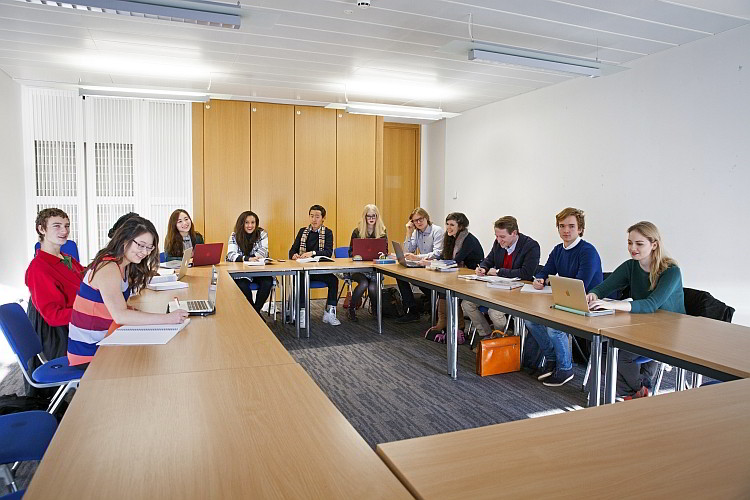
The Unique Academic Identity of St Andrews St Andrews occupies a distinctive place in global higher education, blending an ancient academic heritage with a modern intellectual outlook.
The close relationship between the University and the town creates an atmosphere where students feel connected to centuries of scholarly pursuit while engaging with contemporary global debates.
This sense of continuity gives International Relations students a deeper awareness of how historical processes shape present-day international politics. At the same time, the University’s modern facilities, research-driven teaching, and flexible degree structures ensure that learning remains relevant and dynamic.
For international students, this balance between tradition and innovation offers a reassuring yet stimulating academic home, where global perspectives are valued and actively cultivated.
A School Recognised for Global Leadership in International Relations
The School of International Relations at St Andrews stands as a benchmark for excellence in the study of global politics. Its reputation is built on rigorous scholarship, stimulating research, and an intellectually vibrant teaching culture.
Students explore international issues across times of peace and conflict, drawing on insights from diplomatic history, international law, political theory, economics, and science. This interdisciplinary approach allows students to understand not only how international systems operate, but also why cooperation and conflict emerge.
For international students, this comprehensive framework is especially valuable, as it encourages comparative thinking and sensitivity to diverse political, cultural, and legal contexts around the world.
Rankings and Recognition that Reflect Academic Strength
The global standing of International Relations at St Andrews is reflected in its consistent recognition by leading university guides. These rankings provide assurance to students that they are joining a programme respected both nationally and internationally.
• First in the UK for International Relations – The Times and Sunday Times Good University Guide 2026
• First in the UK for International Relations – The Guardian Good University Guide 2026
• 97% of research activity rated 3* or 4* in the most recent Research Excellence Framework (REF 2021)
Such recognition is particularly beneficial for international students, as it enhances the global credibility of their qualification and signals exposure to research and teaching of the highest standard.
Understanding Global Politics Through Interdisciplinary Learning
International Relations at St Andrews is defined by its breadth and depth of intellectual engagement. Students examine foreign policy, international organisations and regimes, peace and conflict studies, political theory, and terrorism and political violence.
These areas are not treated in isolation; instead, students are encouraged to see how they intersect and influence one another. This integrated approach develops the ability to analyse complex global issues from multiple perspectives.
For international students, this method fosters adaptability and cross-cultural understanding, essential skills for navigating diverse political environments and global careers.
Flexible Undergraduate Study Pathways
The University of St Andrews offers a flexible undergraduate degree structure that allows students to tailor their academic journey according to their interests.
Undergraduate options include the International Relations MA (Hons) and the International Relations BA (International Honours), along with joint degree opportunities that combine International Relations with another subject. This flexibility enables students to pursue specialised interests or broaden their academic profile.
Joint degrees offer the advantage of combining global political study with another discipline, enhancing both academic depth and employability.
Postgraduate Study: Advancing Expertise in International Relations
At the postgraduate level, St Andrews offers a wide range of specialised taught programmes that reflect contemporary global challenges.
Courses such as Conflict and Security in Policy and Practice, International Political Theory, International Security Studies, Peacebuilding and Mediation, Strategic Studies, and Terrorism and Political Violence allow students to deepen their expertise in focused areas of International Relations.
These programmes combine theoretical insight with policy-relevant analysis, enabling students to engage critically with real-world issues.
Postgraduate study at St Andrews provides advanced training in globally relevant fields, strengthening their capacity to contribute to international policy, research, and practice.
Supported Entry and Foundation Opportunities for International Students

Recognising the diverse educational backgrounds of students, St Andrews provides supported pathways into degree-level study. Pathway to Arts programmes offer structured routes for students who meet contextual criteria but not standard entry grades.
In addition, International Foundation programmes are designed specifically to help international students develop the academic skills required for undergraduate study across disciplines.
These pathways are particularly beneficial for international students, as they ease the transition into a rigorous academic environment while building confidence and academic preparedness.
Research Degrees and a Supportive Academic Culture
The School of International Relations also offers MPhil and PhD programmes, supported by a research culture that values intellectual independence and collaboration.
Research typically falls within three broad themes: conflict, peace and security; the evolving character of global and supra-national institutions; and the interpenetration of civil societies and international relations.
Applicants are not required to secure a supervisor before applying, ensuring an accessible and supportive admissions process.
For research students, this structure reduces barriers to entry and ensures that supervision is thoughtfully matched to research interests, fostering a productive and inclusive academic experience.
A Research Environment at the Forefront of the Discipline
Research excellence is central to the identity of International Relations at St Andrews. The School has consistently been placed among the very best in the UK for research quality, with a strong emphasis on world-leading and internationally excellent outputs.
Teaching is deeply informed by ongoing research, ensuring that students engage with cutting-edge scholarship. The School’s commitment to diverse methodologies, ranging from theoretical and qualitative approaches to empirical and quantitative analysis, enriches the learning experience.
For international students, this research-driven environment offers exposure to multiple academic traditions and analytical tools, enhancing both intellectual growth and global academic literacy.
Research Centres that Enrich Academic Life
The School of International Relations is home to a wide range of research centres and institutes that contribute to its intellectual vitality.
These include centres dedicated to art and politics, global law and governance, war and strategy, regional studies of the Middle East and Central Asia, peace and conflict studies, global (post)socialisms, religion and politics, Syrian studies, and terrorism and political violence.
The presence of these centres creates opportunities for students to engage with specialised research communities, attend seminars, and participate in interdisciplinary dialogue.
For students, this exposure broadens perspectives and fosters connections across regions and academic fields.
Teaching Excellence and an Engaged Academic Community
International Relations is one of the most popular subjects at St Andrews, attracting students from around the world.
More than sixty members of staff contribute to teaching and supervision across undergraduate and postgraduate programmes. This breadth of expertise ensures diverse viewpoints and academic depth.
The School’s teaching environment is described as friendly, intellectually stimulating, and vibrant, encouraging students to actively participate in discussion and debate.
For students, studying in the UK, this supportive atmosphere helps build confidence, encourages cultural exchange, and enhances the overall learning experience.
Facilities Designed for Collaborative Learning
The School of International Relations is based in the purpose-built Arts Building, centrally located in St Andrews. This modern facility includes lecture theatres, seminar rooms, study spaces, and academic offices, creating a cohesive environment for learning and research.
The central location reinforces the integration of academic life with the wider University community. For international students, access to well-designed facilities supports collaborative study and fosters a sense of belonging within the academic environment.
A Rich History that Shapes Contemporary Study
International Relations has been taught at St Andrews since 1978, with the discipline evolving steadily over the decades.
The establishment of a dedicated department in 1990 and its transformation into a School in 2003 marked significant milestones, making it the first School of International Relations in Scotland. This history reflects sustained growth, academic ambition, and responsiveness to global change.
For international students, studying within a School that pioneered the discipline nationally adds historical depth and prestige to their academic journey.
A Strategic Vision for the Future
The School of International Relations is guided by a strategic plan that emphasises empowering future global leaders.
Its commitment to pioneering research, inspiring teaching, innovative learning experiences, and the cultivation of global citizens underscores its forward-looking mission. Critical thinking, cultural understanding, diversity, and inclusion are central to this vision.
For students, this focus ensures an education that is not only academically rigorous but also globally conscious and socially engaged.
Conclusion: Preparing Global Thinkers in a Historic Setting
Studying International Relations at the University of St Andrews offers an immersive and transformative academic experience.

Rooted in centuries of scholarly tradition and shaped by contemporary global challenges, the programme equips students with the knowledge, analytical skills, and global awareness needed to understand and engage with international affairs.
The School’s outstanding rankings, research excellence, interdisciplinary approach, and supportive learning environment make it an exceptional choice for students from around the world.
For international students in particular, St Andrews provides a welcoming and intellectually rich setting where diverse perspectives are valued, and future global leaders are shaped.
In this unique meeting of history and global inquiry, students do not merely study the world; they learn how to think critically about it and contribute meaningfully to its future.
Dreaming of studying International Relations at the University of St Andrews in the UK? Book a Free Consultation with ScholarshipKart and let our expert counsellors guide you towards the perfect course match and a strong scholarship application. From IELTS preparation for crafting a winning profile to ensuring a smooth admission process, we help you make every step count.
The University of St Andrews offers a strong academic environment for International Relations, combining a long academic tradition with interdisciplinary teaching, research excellence, and globally recognised academics.
International Relations at St Andrews was ranked 1st in the UK by both The Times and Sunday Times Good University Guide 2026 and The Guardian Good University Guide 2026. The School also reported that 97% of its research activity was rated 3-star or 4-star in REF 2021.
Undergraduate options include the International Relations MA (Hons) and International Relations BA (International Honours). Students can also explore joint degree options combining International Relations with another subject.
Students can explore areas including foreign policy, international organisations and regimes, peace and conflict studies, political theory, terrorism, political violence, diplomatic history, international law, economics, and science.
Yes. Postgraduate options include specialised programmes such as Conflict and Security in Policy and Practice, International Political Theory, International Security Studies, Peacebuilding and Mediation, Strategic Studies, and Terrorism and Political Violence.
Yes. The School offers MPhil and PhD programmes supported by a strong research culture. Research areas include conflict, peace and security; global and supranational institutions; and the relationship between civil societies and international relations.