
Economics has always been central to how societies grow, adapt and respond to change, and the University of Leeds has built a global reputation for teaching economics as a living, evolving discipline rather than a purely theoretical subject.
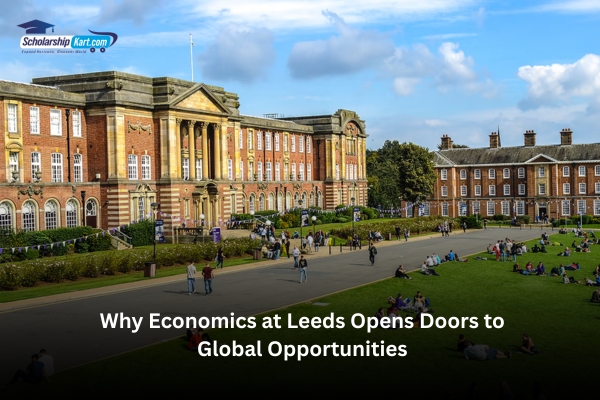
At Leeds University Business School, economics is taught as a powerful tool for understanding the real world, how governments design policies, how businesses make strategic decisions, and how societies respond to global challenges such as inequality, financial instability and climate change.
This practical and policy-relevant approach is one of the key reasons why Leeds is widely recognised for excellence in economics education.
The Economics Department at Leeds University Business School is known for its pluralistic outlook. Rather than limiting students to a single school of thought, it encourages debate, comparison and critical evaluation of different economic perspectives.
This broad intellectual approach is grounded in real-world insight, allowing students to connect economic theory with the challenges shaping global economies today.
Combined with the Business School’s prestigious triple accreditation from AACSB, AMBA and EQUIS, Leeds stands among a select group of business schools worldwide recognised for outstanding teaching quality, research excellence and global relevance.
Dreaming of studying Economics at the University of Leeds? Let ScholarshipKart turn your ambition into admission. From IELTS coaching and SOP guidance to personalised course selection and application support, we help you navigate every stage from application to visa process with confidence. Reach out now and begin your path to success in the UK!
Studying Economics at Leeds: Building Skills for a Changing World
Let us delve deeper into how studying Economics at the University of Leeds equips students with the knowledge, perspectives and skills to thrive in a rapidly changing world:
Global Prestige Backed by Rankings and Recognition
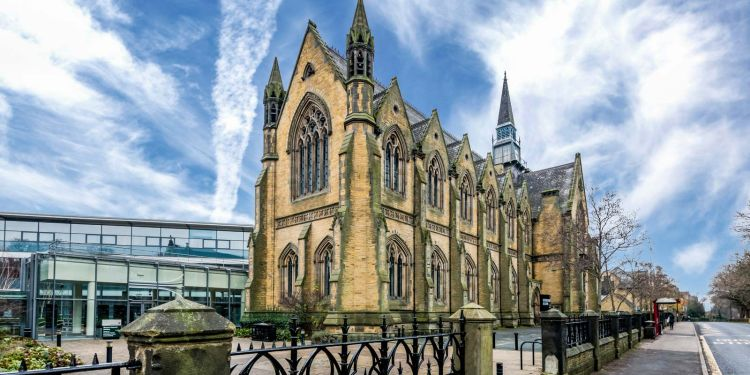
Leeds’ reputation for economics is reinforced by strong national rankings that reflect both teaching quality and academic strength.
Top 10 in the UK for Economics – Complete University Guide 2026
Top 10 for Economics and Business Management – The Times and The Sunday Times Good University Guide 2026
These rankings highlight the consistency of Leeds’ performance and its standing among the UK’s most respected universities for economics education.
For international students, this recognition provides confidence that their degree will carry strong academic and professional value across global job markets.
Research That Shapes Policy, Practice and Society
Research lies at the heart of economics at Leeds. The department’s work is driven by a clear ambition: to transform the economy in ways that promote better lives for all. Research is policy-relevant, realistic and grounded in real-world economic challenges.
Academics combine a wide range of economic ideas and methods, demonstrating strength in both disciplinary and interdisciplinary research.
The department’s research is organised around four interconnected themes. Labour, Wellbeing and Behavioural Economics explores how individuals behave in real economic settings, examining issues such as labour markets, health, wellbeing, gender and family economics.
Macro-Finance focuses on large-scale economic dynamics, including monetary economics, international finance, open-economy macroeconomics and global economic stability.
Development, Trade, and the Environment addresses some of the most pressing global challenges, from development and inequality to environmental sustainability, trade and regional economic growth.
Pedagogy and research-led teaching ensure that innovations in economics education directly shape how students learn, engage and develop critical thinking skills.
This breadth of research ensures that students are taught by academics actively contributing to debates that influence public policy and economic decision-making worldwide.
For international students, this exposure offers a global perspective on economic issues that transcend national boundaries.
A Teaching Philosophy That Builds Independent Thinkers
Economics programmes at Leeds are designed to develop independent, critical thinkers who can analyse complex problems and propose informed solutions.
Teaching emphasises a broad range of perspectives, encouraging students to question assumptions and understand the implications of competing economic ideas. This approach equips graduates with skills that are relevant across sectors, including public policy, finance, business and the third sector.
Studying economics at Leeds means learning in a world-ranked, triple-accredited business school with a global reputation for excellence. Teaching is directly informed by real-world business and policy contexts, ensuring that students graduate with both theoretical understanding and practical insight.
This balance is particularly valuable for international students aiming to apply their learning in diverse economic and cultural environments.
Undergraduate Economics: Building Strong Foundations
The BSc Economics programme offers a challenging yet supportive environment where students explore a wide range of economic perspectives and real-world applications.
The course covers core concepts and techniques of economic analysis, helping students understand how income is generated and distributed, how economies grow, and how individuals and firms behave in different contexts.
Through compulsory modules, students gain a deep understanding of economic methods while developing analytical, quantitative, computing and presentation skills valued by employers worldwide.
The BSc Business Economics focuses on the application of economics within business contexts. Students explore how individual behaviour, firm strategy and market interactions shape economic outcomes.
The programme develops strong analytical and quantitative skills while offering insight into policy options and economic dilemmas faced by organisations. This degree is particularly appealing to students interested in careers that bridge economics and business decision-making.
The BSc Economics and Finance allows students to study the intersection of economics and financial systems. Alongside core economic analysis, students gain knowledge of financial markets, institutions and corporate finance.
Optional modules enable exploration of specialist areas such as behavioural economics, monetary policy, international banking and auditing.
Leeds’ position as one of the UK’s largest centres for financial and business services makes it an ideal location for studying economics and finance, offering exposure to industry-relevant opportunities and practical experience.
Across all undergraduate programmes, students can tailor their learning through optional modules covering areas such as labour economics, international trade, health economics and monetary policy.
Opportunities to spend a year in industry or study abroad at partner universities further enhance global exposure and employability, particularly for international students seeking cross-cultural experience.
Learning Beyond the Classroom
Economics students at Leeds benefit from regular engagement with industry and policy professionals.
The ‘Meet with the Economists’ series brings guest speakers from industry and politics to campus, offering debates, discussions and presentations that sharpen professional communication skills and deepen understanding of real-world economic issues.
Students also develop practical data analysis skills using software and real datasets, preparing them to solve complex economic problems faced by organisations today.
Courses place a major focus on research and independent inquiry. In the final year, students apply their analytical and research skills to a year-long project on a topic of their choice, gaining experience that mirrors postgraduate study or professional economic research.
Postgraduate Economics: Advanced Learning with Global Impact
The MSc Economics at Leeds University Business School delivers advanced learning, cutting-edge research and practical solutions that give graduates a strong career advantage.
The programme addresses the growing global demand for economists capable of tackling challenges such as climate change, financial instability and societal welfare. It adopts an interdisciplinary approach, combining advanced economics and econometrics with insights into global political and economic relationships.
Students study both mainstream economic theory and alternative critical perspectives, gaining a nuanced understanding of issues ranging from firm-level decision-making to global macroeconomic dynamics.
Optional modules allow students to tailor their studies to specific interests, including behavioural economics, monetary theory and applied econometrics. Access to the Applied Institute for Research in Economics places students at the centre of world-leading economic research.
The MSc Economics and Finance combines sophisticated economic theory with advanced financial analysis. Students explore microeconomics, macroeconomics, econometrics and corporate finance, while also gaining exposure to financial economics tools used in investment analysis and financial services.
Teaching draws on expertise from specialist research units, including the Centre for Advanced Study in Finance and the International Banking Institute. A state-of-the-art trading room allows students to develop practical, industry-relevant skills.
Both master’s programmes reflect Leeds’ pluralistic philosophy, encouraging debate between different economic schools of thought and preparing graduates for a wide range of career paths.
Guaranteed Industry Experience and Global Exposure
All master’s students at Leeds University Business School have access to guaranteed industry experience through a two-week online Global Industry Programme.

Working with international clients on real consultancy projects, students gain hands-on experience, build professional networks and develop practical skills highly valued by employers.
International study tours further enhance global exposure through company visits, guest lectures and networking events.
Exceptional Career Support and Employability
Leeds is one of the most targeted universities by graduate recruiters in the UK, ranking fourth according to High Fliers Research. It is also ranked joint ninth in the UK for graduate employability in the QS Graduate Employability Rankings 2022.
Dedicated employability and opportunity teams support students with career coaching, CV writing, interview preparation and networking opportunities.
The University’s Careers Service provides lifelong support, offering access to global job databases, recruitment fairs and employer-led workshops.
For international students, specialist resources such as Student Circus and GoinGlobal provide tailored guidance for building careers across borders.
A Global Campus in a Thriving City
Leeds is a truly international university, with more than 14,400 students from 137 countries. Ranked among the top 100 universities globally in the QS World University Rankings 2026, it offers a multicultural learning environment that enriches academic and personal development.
As a Russell Group university, Leeds places research at the heart of teaching, with 90 per cent of Business School research rated as world-leading or internationally excellent in the REF 2021.
The city of Leeds itself enhances the student experience. As the UK’s largest centre for banking outside London and a hub for digital innovation, SMEs and start-ups, it offers rich opportunities for internships, networking and career growth.
Cultural festivals and creative events further contribute to a vibrant student life.
World-Class Facilities Designed for Economics Students

Economics students at the University of Leeds study in world-class facilities at Leeds University Business School, primarily based in the Maurice Keyworth Building, the central hub of the School, alongside key buildings such as the Esther Simpson, Newlyn, Charles Thackrah and Clarendon Buildings on the western edge of campus.
Teaching takes place in large, state-of-the-art lecture theatres designed for comfort, concentration and digital interaction, including Harvard-style theatres seating over 200 students and traditional lecture theatres accommodating up to 390.
Modern seminar rooms and collaborative teaching spaces support discussion, group work and research-led learning, all equipped with the latest interactive and audio-visual technology. Students also benefit from computer clusters, contemporary breakout spaces, cafés and boardroom-style facilities.
A major highlight is the state-of-the-art trading room, which enables hands-on experience of financial markets through virtual trading platforms, alongside specialist behaviour labs for data collection and observation.
Campus-wide WiFi ensures seamless access to learning resources across the university.
Conclusion
Studying economics at the University of Leeds is about more than earning a degree; it is about gaining the knowledge, perspective and skills to understand and influence the world.
Through its pluralistic teaching, policy-relevant research and strong industry connections, Leeds prepares students to think critically, act responsibly and make a meaningful impact in their careers.
For international students in particular, Leeds offers a globally recognised education, rich cultural diversity and exceptional career support. Economics at Leeds is not just an academic journey; it is a foundation for shaping the future.
Ready to study Economics at the University of Leeds? Book a Free Consultation with ScholarshipKart today and get expert guidance on choosing the right course, preparing your application, securing your visa, and unlocking scholarship opportunities. Take the first step toward your UK education journey with professionals who understand every step of the process.
The University of Leeds combines economics theory with real-world applications, policy discussions, research, industry engagement and practical data analysis.
Leeds is ranked in the Top 10 in the UK for Economics by the Complete University Guide 2026 and in the Top 10 for Economics and Business Management by The Times and The Sunday Times Good University Guide 2026.
Undergraduate options include BSc Economics, BSc Business Economics, and BSc Economics and Finance. At postgraduate level, Leeds offers MSc Economics and MSc Economics and Finance.
Students develop knowledge of economic analysis while building analytical, quantitative, computing and presentation skills. The programme also covers areas such as income distribution, economic growth and individual and firm behaviour.
The programme combines economic analysis with financial systems, including financial markets, institutions and corporate finance. Students can also explore areas such as behavioural economics, monetary policy, international banking and auditing.
Yes. The MSc Economics focuses on advanced economics and econometrics, while the MSc Economics and Finance combines economic theory with advanced financial analysis and corporate finance.