
What makes a university the right place to build your future? For international students, the answer often lies beyond the course itself, in the learning environment, opportunities to grow, connections made along the way and the experiences that continue long after graduation. This is where choosing the right university becomes about discovering what your student journey could truly look like.

The University of Exeter brings these elements together through research-led teaching, strong employer connections, international opportunities and beautiful campuses in Devon and Cornwall.
Located in southwestern England, the University of Exeter is a member of the prestigious Russell Group, a group of 24 research-intensive UK universities. It has developed a strong international reputation for academic excellence, high-quality teaching and research that addresses major global challenges.
The university’s roots date back to 1838, when it was established as St Luke’s College, while it received its Royal Charter in 1955. Today, Exeter is a large international university community of more than 30,000 students, supported by thousands of staff and a global alumni network.
For students looking for a UK university that combines academic study with practical experience, international exposure, research, career development and an active student community, Exeter offers a wide range of opportunities.
Planning to study at the University of Exeter? From choosing the right course and finding scholarships to managing your application and UK visa process, ScholarshipKart can help you navigate every step. Get expert counselling and start your Exeter journey with confidence.
Why Choose the University of Exeter for Higher Education?
There are several reasons students consider the University of Exeter for undergraduate courses, and postgraduate and research study. Its appeal comes from the combination of academic reputation, research intensity, graduate development, international community and location.
At Exeter, education is designed to encourage curiosity, unlock potential and prepare students to take an active role in shaping their futures. Rather than viewing university education simply as classroom teaching, Exeter places emphasis on independent learning, knowledge creation, creativity and practical development.
Some of the key reasons to consider the University of Exeter include:
University of Exeter Rankings and Academic Reputation
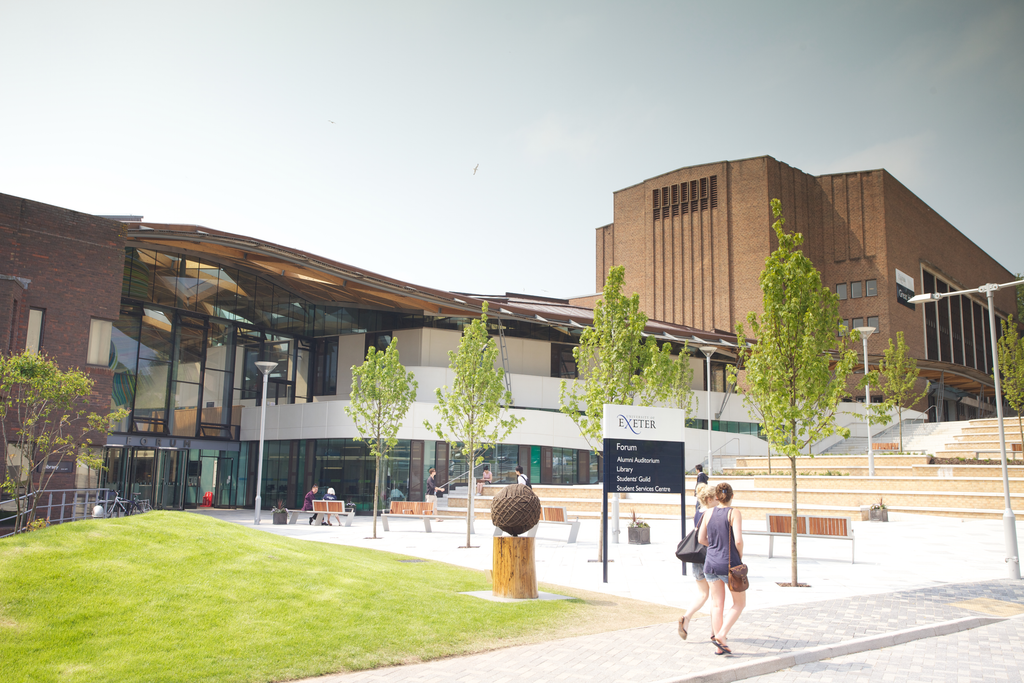
University rankings are one way prospective students assess the academic standing of a university. The University of Exeter has achieved strong positions across UK and international rankings.
For 2027, Exeter is ranked:
- 16th in The Times and Sunday Times Good University Guide 2027.
- 16th in The Guardian University Guide 2027.
- 11th in the Complete University Guide 2027.
- 136th globally and 21st in the UK in the QS World University Rankings 2027.
170th globally and 22nd in the UK in the Times Higher Education World University Rankings 2026.
Exeter is also part of the Russell Group, reflecting its position within the UK’s research-intensive university sector.
The university’s academic profile extends beyond overall rankings. In the Complete University Guide 2027 Subject League Tables, 24 subjects are ranked in the UK top 10, including areas such as Marketing, Sports Science, Psychology, Business & Management, Economics, Accounting & Finance, Engineering, Medicine, and Communication & Media Studies.
The university also performs strongly internationally by subject. In the QS World University Rankings by Subject 2027, 11 Exeter subjects are placed in the global top 50 and 18 are in the global top 100.
These results demonstrate the breadth of Exeter’s academic strengths across different disciplines.
Research-Led Teaching at the University of Exeter
A Research-Intensive Russell Group University
Research is a central part of the University of Exeter experience. The university has significantly expanded both the scale and quality of its research community.
Exeter increased the proportion of its research classified as world-leading by more than 60% and expanded its research community by 70%.
The Research Excellence Framework (REF) 2021 further highlights this research profile. More than 99% of Exeter’s research was classified as being of international standard, while 47% was classed as world-leading.
Twelve Exeter subjects were also among the top 10 for world-leading research impact in their respective areas. The university is described as number one in the UK for world-leading research in Sports Science and Theology & Religious Studies, while 94% of its research is reported as having internationally excellent impact.
For students, research-led education can mean exposure to ideas, findings and methods that extend beyond conventional classroom learning. It can help students develop analytical thinking while understanding how academic knowledge is applied to real-world issues.
Research That Addresses Global Challenges
Exeter’s research extends into areas that have direct relevance to society and the environment. The university has received the Queen’s Anniversary Prize four times for research achievements. The awards recognised research excellence in Medicine and Health – Diabetes and Vascular Health and Research (1996), Children’s Health and Exercise Research (1998), Genetics and Diabetes Research (2005), and Environment and Conservation – Ecotoxicology and Pollution Research (2020).
The university is also ranked joint 20th globally for its work toward the UN Sustainable Development Goals, reflecting its focus on issues connected to sustainability and global development.
University of Exeter Courses and Flexible Learning Opportunities
Students looking for a broad selection of degree options can choose from more than 400 courses across 40 subject areas.
The university’s academic structure includes three major faculties:
- Faculty of Environment, Science and Economy
- Faculty of Humanities, Arts and Social Sciences
- Faculty of Health and Life Sciences
Exeter’s degree programmes are designed to encourage qualities that are relevant to academic and professional development, including creativity, entrepreneurship, leadership, teamwork, analytical thinking, resilience, imagination, and a global outlook.
Students can also expand their academic experience beyond their primary subject. Depending on the programme, opportunities include studying modules from outside the main discipline, taking a placement year abroad and undertaking fieldwork overseas.
This flexibility can help students explore interests beyond the boundaries of one subject while developing a broader academic perspective.
Academic Subjects and Areas of Strength
Students can explore a broad selection of disciplines at Exeter. The university’s subject performance includes notable results across science, health, humanities, social sciences, business and engineering.
In the Guardian University Guide 2027, five subjects are ranked in the UK top five:
Electrical and Electronic Engineering
- Earth and Marine Science
- Biosciences
- Health Professions
- Biology
In the QS World University Rankings by Subject 2027, notable global positions include:
- Sport – 18th
- Geology – 20th
- Geophysics – 22nd
- Environmental Sciences – 23rd
Arts & Humanities entered the global top 100 at 76th, while Life Sciences & Medicine was ranked 131st and Natural Sciences 151st.
These subject-level results offer prospective students another way to assess Exeter according to their individual academic interests.
Modern Learning Resources and Digital Study

The University of Exeter continues to invest in learning environments, study resources and facilities.
Students benefit from an extensive range of academic resources, including dedicated libraries across campuses, access to approximately 1.2 million e-books and around 1 million print books, more than 1,000 databases and digital archives, modern teaching spaces, subject-specific learning facilities, advanced laboratories and specialist resources, and high-quality digital learning tools.
The university also emphasises flexibility, allowing students to use digital learning resources to support study in different settings.
University of Exeter Graduate Employability and Career Support
Preparing Students for the Global Job Market
Graduate employability is another important reason students consider Exeter. The university’s programmes aim to develop the skills, experience and confidence required to adapt to a changing professional environment.
Its Careers and Employability service provides support throughout students’ university journeys. Services include personalised guidance, employer connections, skills development, placements and opportunities to apply academic learning in practical settings.
The university’s graduates are reported as being among the most targeted by UK employers. Exeter is ranked 13th in The Graduate Market in 2026 by High Fliers Research, placing it among the top 15 most-targeted universities by UK employers.
Career development opportunities include:
- Individual career consultations.
- Employer events.
- Workshops and seminars.
- Work experience placements.
- Internships.
- Graduate job opportunities.
- Employability skills development.
- Connections with employers.
- Support from dedicated careers professionals.
Students can also gain experience through volunteering with charities and local organisations.
Entrepreneurship and Practical Experience
Career preparation at Exeter is not limited to traditional employment. Students can explore entrepreneurship through student-led initiatives such as the Exeter Entrepreneurs Society.
These opportunities allow students to develop practical abilities related to business creation, leadership, problem-solving and entrepreneurship.
The university also works with employers and organisations to help students understand real-world professional expectations. Courses across fields such as engineering, medicine, health sciences, law and politics prepare students to apply academic knowledge beyond university.
Scholarships and Funding at the University of Exeter
Financial Support for International Students
Funding is an important consideration for international students planning to study in the UK. The University of Exeter offers several scholarship and funding opportunities designed to support eligible students.
The university invests more than £7 million each year in scholarships for international fee-paying students. Its Exeter Excellence Scholarships offer tuition fee reductions of £3,000 to £10,000, depending on the programme.
Other scholarship opportunities mentioned include:
- Global Excellence Scholarships, representing more than £2.5 million in scholarships for international students.
- Green Futures Scholarships for students from low and lower-middle-income countries.
- Aziz Foundation Masters Scholarships covering subjects including Media and Journalism, Law, Policy, Technology, Sustainability and Environment, and Creative Content.
- Country-specific scholarships and funding opportunities.
- Opportunities connected with programmes such as Chevening Scholarships.
- Commonwealth Shared Scholarships.
- Students should check the eligibility criteria and conditions attached to individual scholarships before applying.
International Student Community at Exeter
A Global University Community
The University of Exeter has a strong international dimension. The university community includes students and staff from countries across the world.
Exeter has more than 7,000 international students from over 150 countries. Together, these figures illustrate the university’s substantial international student population.
Exeter also has staff representing 100 countries, creating an internationally diverse academic and professional environment. The university has partnerships with more than 200 universities and research institutions worldwide, providing opportunities for international study, collaboration and research.
Its global alumni community is also extensive, with 195,000 alumni across 183 countries.
For international students, this diversity can create opportunities to meet people from different backgrounds, exchange ideas and develop international networks.
Support for International Students
Moving to another country for university involves more than academic preparation. Exeter provides support relating to the wider student experience, including:
- Visa and immigration advice.
- Orientation and induction programmes.
- Language support.
- Language exchange opportunities.
- Academic guidance.
- Career support.
- Mental health and wellbeing services.
- General student support.
This combination is designed to help international students adjust to university life and make the most of their time in the UK.
University of Exeter Campuses and Location
Study in Devon and Cornwall
One of Exeter’s distinctive features is its location. Its campuses are situated in Devon and Cornwall, two areas known for their green landscapes and scenic surroundings.
The main locations highlighted include:
- Streatham Campus, Exeter
- St Luke’s Campus, Exeter
- Penryn Campus, Cornwall
Streatham is the largest campus, covering approximately 350 acres. It is described as a green campus with gardens, lakes and extensive open spaces. The campus provides an environment where students can move between academic study, social activities, sports and relaxation.
St Luke’s covers around 16 acres, and supports specific areas of academic study while Penryn covers approximately 70 acres.
The campuses combine historic architecture with modern academic and student facilities, including:
- Libraries
- Teaching spaces
- Laboratories
- Sports centres
- Shops
- Food outlets
- Bars
- Digital learning spaces
- a 400-seat lecture hall.
Penryn Campus in Cornwall offers a different university environment in Cornwall. It has a close-knit student community and shares its campus with Falmouth University, a specialist arts institution. Its location provides access to nearby beaches and opportunities for outdoor activities and water sports. The campus environment also supports connections, innovation, sustainability and personal development.
Student Life, Sports and Societies at Exeter
University life is not limited to lectures, assignments and examinations. Exeter provides opportunities for students to participate in societies, sports and extracurricular activities.
Sports are an important part of campus life, whether students want to compete at a high level or simply try something new.
The university offers:
- Expert coaching.
- Sports facilities.
- Competitive clubs.
- Recreational clubs.
- Opportunities for different levels of participation.
- Pathways connected with partnerships such as Exeter Chiefs.
The university has 52 sports clubs and was ranked 4th in the 2024/25 BUCS Sport Rankings. It was also recognised as the No. 1 Sports University in the South of England and Wales in the 2024/25 BUCS Sport Rankings.
Student societies also provide opportunities to meet people, explore interests and participate in activities beyond academic study.
Accommodation and Student Life in Exeter
Accommodation is another important aspect of studying at the University of Exeter. The university provides a range of options, including purpose-built student accommodation and private rented housing.
The city itself offers a student-oriented social environment, with:
- Restaurants and cafés.
- Bars, pubs and clubs.
- International food options.
- Social and cultural activities.
- Access to surrounding countryside and coastline.
Exeter is a historic city in Devon, approximately 2.5 hours from London by train. Its location provides access to the city’s student environment while also placing students within reach of beaches, countryside and national parks.
A Beautiful UK Location for University Study
The physical environment is one of Exeter’s defining characteristics.

The university’s campuses are repeatedly recognised for their green and botanically interesting surroundings. Students can experience historic buildings alongside modern facilities while remaining close to gardens, lakes and open spaces.
Beyond the campuses, Devon and Cornwall offer opportunities to explore:
- Beaches
- Countryside
- Coastline
- National parks
- Arts and culture
- Food
- Outdoor activities
For students who want a university experience that combines academic study with access to natural surroundings, Exeter’s location provides an important part of the overall student experience.
University of Exeter and Sustainability
The University of Exeter’s identity is closely connected with sustainability and global challenges.
The university works with students and staff to make the world greener, healthier and fairer. Its work includes research addressing environmental and societal challenges as well as efforts toward building carbon-neutral campuses.
Its joint 20th global ranking for work toward the UN Sustainable Development Goals is another indication of the importance placed on sustainability.
The Green Futures Scholarships and research in areas such as ecotoxicology, pollution and environmental sciences further demonstrate the university’s engagement with environmental issues.
Who Should Consider Studying at the University of Exeter?
The University of Exeter may be particularly relevant for students looking for a university experience that combines several dimensions of higher education.
It offers opportunities for students who want:
- Research-led teaching.
- A Russell Group university environment.
- A wide selection of undergraduate and postgraduate courses.
- International study and research connections.
- Career guidance and work experience.
- Entrepreneurship opportunities.
- Scholarships and international funding.
- A diverse global community.
- Sports and extracurricular activities.
- Green and scenic university campuses.
- Access to beaches, countryside and outdoor activities.
- Opportunities to develop academic, professional and personal skills.
The university’s emphasis on creativity, analytical thinking, leadership, resilience, teamwork and entrepreneurship also reflects the changing expectations of modern employers.
Conclusion
Choosing where to study is ultimately about finding an environment in which you can grow into the person and professional you want to become. The right university should give you room to explore your interests, challenge your thinking, discover new possibilities and gain the confidence to pursue what comes next.
For students considering the University of Exeter, the experience extends beyond earning a degree. It is an opportunity to become part of a community, engage with ideas that matter, step outside your comfort zone and make the most of experiences that can shape your perspective.
Whether your ambitions are academic, professional, creative or entrepreneurial, your time at university can become a foundation for the years ahead. Exeter offers a setting where students can learn with purpose, broaden their horizons and make meaningful connections along the way.
If you are looking for a UK university where your education can become the starting point for your wider ambitions, exploring what the University of Exeter has to offer could be the next step in your study journey.
Ready to take the next step towards studying at the University of Exeter? Book a Free Consultation with ScholarshipKart and let our experienced counsellors support you with personalised counselling, scholarship guidance, application assistance, and visa support. Connect with our experts today and turn your UK study plans into reality.
The University of Exeter offers research-led teaching, strong employer connections, international opportunities, scholarships, career support and a diverse global student community. It is also a Russell Group university with campuses in Devon and Cornwall.
Yes. The University of Exeter is a member of the Russell Group, a group of 24 research-intensive UK universities. Pasted markdown
The University of Exeter offers more than 400 courses across 40 subject areas, covering disciplines across environment, science, economy, humanities, arts, social sciences, health and life sciences. Pasted markdown
Exeter has strong academic performance across subjects including Sport, Geology, Geophysics, Environmental Sciences, Engineering, Biosciences, Biology, Business & Management, Psychology and Economics.
Yes. Exeter provides several scholarship and funding opportunities for eligible international students. The university invests more than £7 million annually in scholarships for international fee-paying students, including Exeter Excellence Scholarships offering tuition fee reductions of £3,000 to £10,000 depending on the programme. Pasted markdown
The University of Exeter has more than 7,000 international students from over 150 countries. It also has staff representing 100 countries and partnerships with more than 200 universities and research institutions worldwide.